
RAVEN
-----

RAVEN
Oakley Herald, 4C, 8/13/1920:
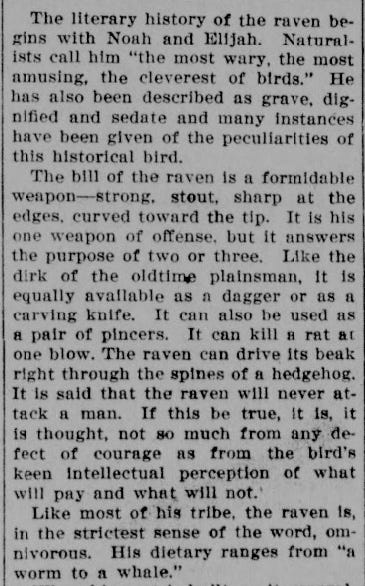
Lewiston Teller, N, 2/19/1891:
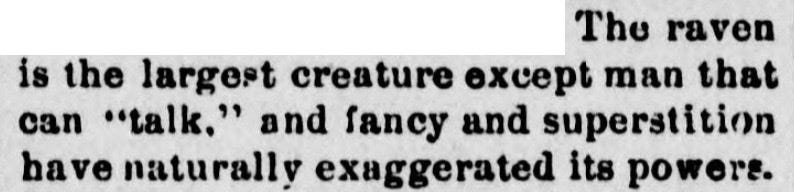
Like…
Ever since the Fur Trade came to town, Raven population-growth has been slow and sturdy — uncomplicated — unquestionably healthy. What other species could this be said of?
Like: Who among us is healthy? Who can afford to stay? Who can afford to have children? Etc..
To be clear, the Raven is a species ‘native to the Snake River Plain’ (= ‘living in the SRP prior to the Fur Trade’s arrival in the SRP’). Though a significant feature throughout the native landscape (Intermountain and Pacific Northwest), the Raven does not appear so much in our popular-intuitive lists of Native Species anymore... When thinking of Native Species now, we tend to think of the ones we are harming through our development of “our resources” (Sage Grouse) over the ones we are helping through our development of “our resources” (Raven). This is understandable of course, but we are missing a thing. Like, as we humans are well aware, we have been for-a-while-now engaged in a big process of transforming this world into an uninhabitable hellscape for ourselves. So we see all the animals extincting around us and we are correct to feel affirmed in our sense of Doom — correct to feel that, whatever we’re doing, it’s working. But is it really working for us? Is the point of all these weird and otherwise excessive labors that we keep ramping up for some reason1 really to just, like, in accordance with our Doom, create this hellscape for us? Look around your average hellscape, through the piles of rotting flesh and etc, and you see a number of plant animal fungus species that are doing just fine — flourishing even. Which of these are native? Is it not possible that this was for them all along ? Is it not possible that the whole point of all this is humankind’s fabrication of what is, to one particular native species, Paradise?
See again the flourishing of the Raven…. The Raven adores our asphalt, our sprawl, our Housing Market, our McNuggets. These things we make that are bad for us, and for our more Idaho-Iconic Animals, are good for the Raven.
Note: The USA has no has no trickster animal gods because the USA does not believe it can be tricked by an animal. It’s gods inhabit the lesser sphere where such possibilities are not supposed to be possible.
Compare-and-Contrast the pre-Fur Trade Times — where there were not these lesser gods situated between the humans and the greater bird — as re-iterated through various stories throughout the Intermountain and Pacific Northwest (especially the Pacific Northwest): The Raven is a trickster, a shapeshifter, a world-creator, a world-transformer, a world-manipulator, whose favorite playthings are the humans.
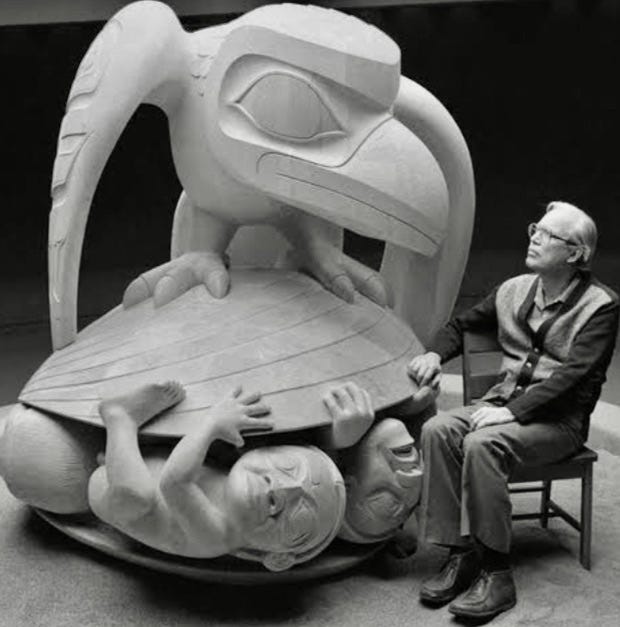
See, for instance, the Haida story of Raven’s discovery of men under a clamshell at low-tide on a beach on Haida Gwaii:
There was a time, before the first humans, when water covered the earth. Over an endless expanse of sea, flew Raven, bored…. It was a time when anything was possible. Boundaries of earth, sky, and sea, were made non-existent. All beings were able to pass from one domain to another through miraculous powers of transformation…. Raven, through cleverness, trickery, and even outright theft, traveled about, changing things to his liking.2
Raven fiddles around with the little guys — coaxes them out from under their shell. They are squeaky and bewildered. They are adorable to Raven. They become little explorers. Raven teaches them some trix, makes them fight with each other, Etc.. Then the Raven gets bored and, so, mates them with little women, which is an interesting challenge because, at this point, everyone is shy. It eventually works and the ensuing Humanity becomes more interesting to Raven. Raven messes around with them forever. Raven gives to them things like Sun, Moon, Fire, and Salmon, just to see what will happen next.
(…)
Compare-and-Contrast the Ancient Greek Times — first with some lesser gods between the humans and the greater bird, then without the lesser gods between the humans and the greater bird:
The gods there were initially situated above the humans, below Fate. The gods were wielded by Fate, or were at least subordinate in their whims to the three basic requirements of Fate (= Anything = Nothing = Death ). But neither gods nor mortals could know this. The gods remained gods over the mortals, upheld in their divine offices, only insofar as Fate remained senseless to gods and mortals ( = Anything = Nothing = Death) — only insofar as both gods and mortals really believed that whatever the gods were doing to the mortals was because of the gods’ own whims. Which got pretty confusing… For instance, “Why do the gods keep killing people?”: People blamed Zeus — blamed the arbitrariness, and/or the indifference, of Zeus. Zeus, meanwhile, blamed the “blind folly of mortals” — speculated that it must be because of the “blind folly of mortals” that the mortals are suffering so much “sorrow beyond that which was ordained”. They bickered for 100 years. Then, because of Athenian imperial expansions, some Athenian deities felt comfortable-enough to overstep their bounds a bit. They prevented the death of a special mortal who was supposed to die. Then Fate realized it was being violated. Then all Fate’s Furies awoke and shouted, “A sterile blight must pock the earth’s face with infections sores!” Then a horse ate itself. Then there occurred throughout the Empire a “Tragic Realization” as, into the Empire, the former senselessness of the all-overarchingness of Fate started to make no sense = produce the no-sense = induce the blindness / deafness / dumbness / numbness in which philosophers discovered, “I know nothing”.3 Then that horse regurgitated itself out of thin air. Then a maniac ran into the agora and shouted,
Zeus is gone! Vortex now rules!
And so on. And so on. And so… Nothing made sense anymore, philosophers realized, because Fate had been the one making it do that all along. Then, because of reasons so far lost to history, philosophers started perceiving, in all this nonsense they were realizing, the croaking of the Raven = the being of the Raven (?) = Ho Ornithos (?) = the ancient greek word for “The Bird” = not incidentally, also, the ancient greek word for “The Omen”…. Then the philosophers started trying to be more cheerful about the logicalness of the mandatoriness of their obedience to such ominousness. So says Epictetus:
When Raven croaks with evil omens, rejoice. All omens are favorable.
(…)
In 1930, in his short essay, “Economic Possibilities for Our Grandchildren”, Famous British Economist John Maynard Keyes predicted that, with Technological Progress and all, the average grandpeople of the year 2000 would only have to work 3 hours per workday, 15 hours per week. Obviously though, this did not happen. Through 100 years worth of awesomeness in our Technological Progress, there has occurred no adjustment in the standardness of the 40 hour workweek. Why? Why are we still working this much? (…) Or in other words: The machine that puts you out of your job and the machine that does your job for you are the same machine. Why are we using these fantastical labor-saving devices in this one way (to increase productivity, to cut costs, to put you out of your job, to create jobs for you, etc.), and not in that other way (to save labor)? (…) Large quantities of very impressive mathematics have been expended in the description of all sorts of very deep wisdoms here about Human Nature and the infiniteness of Our Consumer Requirements and liberatory qualities of our Bit Coins. It is better though, I think, to take a non-deep approach. Like, whatever may be the deeper reasons for us still working this much, we are just still working this much. We must resist the temptation to be wise. The thing we are doing all this extra work for (whether it be a thing deep in our own hearts, or some nefarious or perhaps benevolent external entity, or some combo of these things, or perhaps some complexity just to complex for us to understand), we will call just “X”. In this way, we can ask the math question now: How many hours per week am I working for X? (…). Precision is hard. A very rough idea, though, is easy. Say, for instance: Keynes was correct. Technology in the New Millennium (its labor-saving capacity) is exactly as awesome as Keynes predicted. He was just oblivious about X. So if only 15 hours of weekly labor are still necessary to maintain a good standard of living for a standard household, then 25 of the standard 40 hours must be now for X. (…) Here, though, we are assuming that X did not arrive until after 100 years ago — are not accounting for the portion of the original “Standard 40 Hour Workweek” that was already for X. Also, we are asking no questions about all the resources employed overseas for the sake of our post-WW2 “Freedom”. ((It is “God-Given”. It is “Not Free”. It is a Truth we are “holding to self-evidence”.)) Those are a lot of resources… And then, on top of all that, there has been a big social development in the last 100 years. When Keynes was talking about 15 hours of work, he was talking about the waged work of the mid-20th Century “Head of Household” = The Dad. He was not considering the unwaged work of the Mom = taking care of everything in the house and the 2 children and Etc.. He was also not considering the possibility that this Mom might start doing 40 hours of waged work a week, too. So, to say the least, it would’ve surprised him that, now, in the New Millennium, with all this Modern Technology and all, the number of waged work-hours presupposed in the maintenance of “The Standard Household” has doubled. 65 hour a week for X? And then, of course, what we are here calling “The Standard Household” is really just the old-timey Nuclear Household (= Mom + Dad + Little Jasper + Baby Jean). Is a standard 80 hours per week still enough for a standard Mom and a standard Dad to ensure a good standard of living for two unworking and especially expensive household-members, too? If no, it would help explain the next big social development which I have been hearing about in health insurance commercials lately: “The Chosen Family”…. The Chosen Family is, for rough approximation, a household composed of 4 educated working adults, sustaining a good standard of living for their collective household (even a collective Health Insurance Plan) through 160 hours of waged work per week. 145 hours a week for X? Or if you want to put that in terms of individuals in private apartments, 91 %, or about 36 and a half hours per week, for X? But then, of course, being unique and materially separated individuals comes with additional expenses. And Etc. And Etc.. (…) (…)… In Short: Despite the obvious imprecisions and inconsiderations of my sketch here, the question is at least a worthwhile question: Is it all for X yet?
Narration from intro to Haida Gwaii: Islands of the First People, 1990, produced by the BBC, viewable on youtube. Good documentary…. For one especially good depiction of Raven and the First Men, see Bill Reid’s monumental sculpture, carved from a single block of wood, called “Raven and the First Men”.
Here he is with it:
////////////////////////////////////////////////////////////////////////////////////////////////////////////////////////////////////////////////
Interesting transition here…. Notes……….. For Starters: Contrary to some basic bullshit, Logic is requiring nothing of us, or of the universe. Reason does not contain within itself ‘a reason’. (…) See, for instance, the first of the three classical “Laws of Thought”: A is A. It is saying nothing about A — is requiring nothing of A — is permitting anything of A. It is not even precluding the possibility that A is not A, too. Which is fine…. The problem does not start being a problem until we start trying to obey it. In this way, we misunderstand the nothing this law is saying as something we must be not understanding — something that is, like, logically, mandatory. Senselessness transforms into Nonsenseness. The First Law of Thought starts making no sense — producing the no-sense — inducing the blindness / deafness / dumbness/ numbness in which philosophers will realize that they cannot see things being things, or know that things are really things, or understand what is the point of things being things. All the Deep Questions … Of Nature: How is A A? Of Knowledge: How can we know that A is A? Of the Meaning of Existence: What is the point of A being A? Of Reality: “Is A, like, really A? And so on. (…). Note: I’m being a Wittgensteinian here. Ludwig Wittgenstein says: The man who said one cannot step in the same river twice said something wrong; one CAN step in the same river twice. (…). Other good line: The deepest problems are really no problems. (…) Ludwig Wittgenstein’s basic idea (see his preface to his Tractatus Logico-Philosophicus) is: A philosophical problem is, at bottom, a misunderstanding of what logic says. What logic says is nothing. A philosophical problem is, at bottom, a misunderstanding of nothing. So, once properly understood, this misunderstanding is no misunderstanding at all. The nonsensical problem dissolves in its original senselessness, “like a lump of sugar in water”. (…) And maybe further: The History of Philosophy will vanish from History. The Riddle will no longer have ever existed. Humanity will be thus restored to its original Paradise, having never’ve fallen prey anymore to the temptation to have Deeper Problems. (?) ((Side Note: CS Lewis tells us there is an Elevator, or some other sorta newfangled technological contraption, which can transport anybody from Hell to Heaven anytime they want, and that nobody in Hell ever uses it this way because they have Deeper Problems. (?))) (…) In the meantime, though, there are 2,500 years worth of compounding confusions here. Daunting Complexities. Etc. They can be hard to ignore, but we should at least try. Unlike in Science and Technology, more like in Magic, there are not “developments” in the History of Philosophy. Philosophy does not progress. Philosophy repeats. Philosophy bangs his forehead against the First Law of Thought, gets confused, then repeats. And through 2,500 years of this, there has occurred only one really noticeable shift. See again LW:
The First Law of Thought used to seem of fundamental importance, but now the proposition that this Law is nonsense has taken over in importance.
Say Like: Where Ancient and Medieval wisdom-wanters generally preferred to try to understand the nothing this law was saying to them (Disguised Nonsense, in the form of The Invisibility of Nature and/or The Unknowability of Knowledge), the Modern wisdom-wanters are generally preferring to react to, or re-enact, the nothingness of what this law is saying to them (Patent Nonsense, in the form of "The Meaning and/or Meaninglessness of Existence”).
Some little shifts back and forth in the ancient times, and also all over the place. But Big Shift to the modern mode seems to coincide with the Industrial Revolution. Here, for examples from books, are four especially explicit examples from books:
ONE: PHILOSOPHICAL INQUIRIES INTO THE NATURE OF HUMAN FREEDOM, 1809: Wilhelm Joseph Schelling, “The Prince of the Romantics”, as his wife is dying of dysentery, towards the beginning of the book, right before he really get goin’, writes:
The profound logic of the ancients distinguished subject and predicate as the antecedent and the consequent and thus expressed the real meaning of the Law of Identity. Even a tautological statement, if it is not to be altogether meaningless, retains this relationship. Thus if one says: ‘A body is a body’; he is assuredly thinking something different in the subject of the sentence than in the predicate. In the former, that is, he refers to the unity, in the latter to the individual qualities.
Can you see what he’s doing here? He is assuming (for some reason) that there must be some “real meaning”, some “higher application”, of First Law of Thought = the “Law of Identity”. He is assuming (for some reason) that the logical statement—“a body is a body”—must be “not altogether meaningless”.…. Why? What is necessitizing this here? Why exactly must the logical statement—“a body is a body”---be “not altogether meaningless”? Why exactly must the First Law of Thought have some “higher application”?
What happens next is easy to guess: Schelling misunderstands the altogether- -meaninglessness of the logical statement, and of the First Law of Thought. He writes a super crazy and devastating book of unthinkable profundity about the nature of Evil, and of Pain, and of the will of “The Creature”.
TWO: ON THE SUFFERINGS OF THE WORLD, 1850: Arthur Schopenhauer, the great petty bourgeois nihilist of the mid-19th Century, hates Schelling. He disagrees with him, too. He says that, actually, the First Law of Though is altogether meaningless — is saying nothing about anything — is requiring nothing of anything. Which is correct… But then Schopenhauer does a strange thing. He supposes that the anything that this “law” permits must subordinate itself to the nothing that this “law” requires. He proclaims what the Ancient Enthusiasts proclaim: that underneath the newfangled wisdom of Imperial Apollo (“Know thyself” — “Be Yourself”), there reigns the deeper and more-primordial wisdom of Silenus (“To not be born is best. Second best is to die as soon as possible.”).... Then he gets sad. Then he explains:
Existence is a disruption of the blessed calm of nothingness. Life is expiation for the crime of being born.
THREE: MOBY DICK, 1851: Ahab gets his leg bit off by a whale. Then he gets upset. Then he looks into his reflection in the face of the sea and wonders:
Is Ahab Ahab?
Deep Problems ensue: Ahab mistakes the senselessness of his question for his realization of ‘no sense of something’ — this which seamlessly transforms into his experiencing of the presence of “some nameless, inscrutable, and unearthly thing” — which then clarifies itself as his “hidden lord and master” — which then enlarges into “The Ungraspable Phantom of This Life” — which then appears to him in the distance as “a grand hooded phantom, like a snowhill in the air” — which then, as it approaches, takes on the shape of a certain White Whale. Then Ahab gets himself and his whole crew killed while he is trying to murder that White Whale.
Q: What was “that cankerous thing in his soul”?
A: It was nothing.
FOUR: MAGICK WITHOUT TEARS, 1943: Aleister Crowley, that notorious magician of the Late British Empire, writes,
Knowledge is, moreover, an impossible conception. All propositions come ultimately back to “A is A”.
Can you see what he’s doing here? He’s mistaking the senselessness of the First Law of Thought (“A is A”) for the nonsenseness of everything. He is supposing that, because “A is A” is a senseless proposition (telling us nothing about A), and a nonsensical “law” (requiring nothing of A), all sensical propositions (which are telling us something about A, and which are presupposing the A-ness of A) must be secretly nonsense.
He keeps going from there: He supposes that this nonsense must be mandatory (pretty-soon to outburst from the mouths of all things, and all knowledge, at the noontime of the Aeon of Horus), and that it is the Magic Word = your true and deeper and Magical Identity = The Oneness of the Cosmos = The Secret Identity of the Cosmos. So says Crowley:
The interpenetrating Spirit, without and within. Is not its name ABRAHADABRA?
And he elaborates:
Such a word should in fact be so potent that man cannot hear it and live…. Such a word indeed was the lost Tetragrammaton. It was said that at the utterance of this name the universe crashes into dissolution.
Then he explains that magical words like ‘ABRAHADABRA’ are probably “barbarous names”, probably taken “from some corrupt, if not completely meaningless jargon”. Then he adds,
However this may be, it works!
Then he goes further. He says,
It is because the name is senseless that it is effective.
(…)
(…)
(…)
In short: It is a simple nonsense, but one that fractatalizes through repetition, through various modes, and through sub-confusions, and through unsatisfying solutions to those sub-confusions, and through sub-sub-confusions, and corresponding little wisdoms, and critiques about those little wisdoms, and realizations of Deeper Problems with those critiques about those little wisdoms, and Deeper Questions expressive of those Deeper Problems, and Magic Words expressive of those Deeper Problems, and so on, and so on, and so on. In this way, the nonsense we call “philosophy” has managed to wriggle its way into otherwise sensical historical mechanisms — has managed to embed itself increasingly deep into the Arc of History — and this to degree that Fate, itself, has become infected — has become confused.
(…)
Definitions:
FATE = Whatever Happens. Not possible to contradict, obviously… It is the Nothing the First Law of Thought requires = the Anything the First Law of Thought permits.
See also…
DOOM Where Fate, itself, starts telling us about itself. Where the nothing that is necessary (= the anything that is possible) mistakes itself for the necessity of Death. This in one of two ways:
Micro-Doom: Where the nothing inside you that is needing you to “know thyself”, and/or “be yourself”, decides that, even more importantly, you must die.
Macro-Doom: Where the overreaching of gods awakens Fate from its innate indifference to its reign over the cosmos… Where Fate becomes aware of itself — realizes its own ultimate necessity and, so, mistakes ‘itself’ ( = nothing) for something that is necessary and, so, reasons that there must be nothing ( = zero things) --- then concludes that what this means is that everything in the whole universe must die.
See also…
DREAD An unfulfilled DOOM = the obviousness of the disparity between DOOM (which is what Fate says about itself) and FATE (which is what Fate is).
Note: Doom is more-often followed by Dread, not the Death it promises. And, though Dread might feel the worst of the big D’s (DREAD, DOOM, DEATH, but maybe not DYING), it’s not such a bad thing. It’s what the body feels through the process of falsifying its Doom. Or as the Marines might say: It is Doom leaving the body.
(…)
(…)
Note: At the end The Furies (Aeschylus), the gods of Athens are, through the powers of rhetoric, able convince the Furies to not obliterate the Universe. The gods explain that the lives of mortals are worthwhile because, actually, being venerated by mortals is nice. The play ends with all Fate’s Furies proceeding into the city of Athens, to thrive and be venerated by the mortals of Athens for the remainder of Eternity.
Note: Doom enters the body. The old structures atop the acropolis, good enough for the old local gods, are insufficient to house the Destiny of the Universe, too. Thus Athens must now hijack the defense fund of the Delian League to fund its building of its Parthenon. Thus Athens must take over the Delian League. Thus must begin the Athenian Empire.
Note: As Athens conflates its own material requirements with cosmic spiritual requirements, the Cosmos becomes, as far as the Athenians are concerned, much too fragile to bear. So says Sophocles: Oh, generations of men, how close to nothingness I estimate your lives to be.
(…)
(..)
Note: Same with America? Doom enters the body. We won the Cold War and, at the same time, the Communist International Fantasy collapsed in the face of Reality.
(…)
(…)
(…)
And so on to today: How many of the things I do do I do because they are realistic?
(…)
See again footnote No. 1: Questions of X….
(…)
(…)
The museum of Anthropology at UBC is second only to the National Anthropology museum in Mexico City, in my opinion as a visitor… and Im no Anthropologist, just a commoner learning a few things here and there. The Raven is a nice topic for exploration and has some story legs as you provided… and I like the never ending footnotes!!
Amazing footnote trail
You are a the Pierre Bayle of the Snake River Plain