
FRUIT
-----

FRUIT
Shepp’s World Fair Photographed, 1893 — The Idaho Room in the Horticultural Building at Chicago’s World’s Fair:
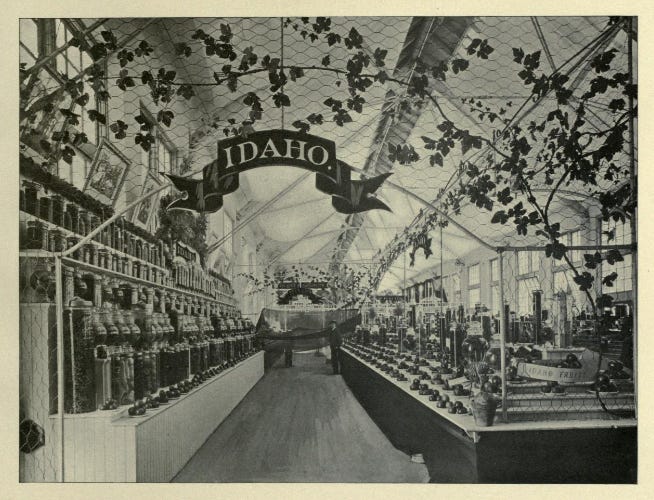
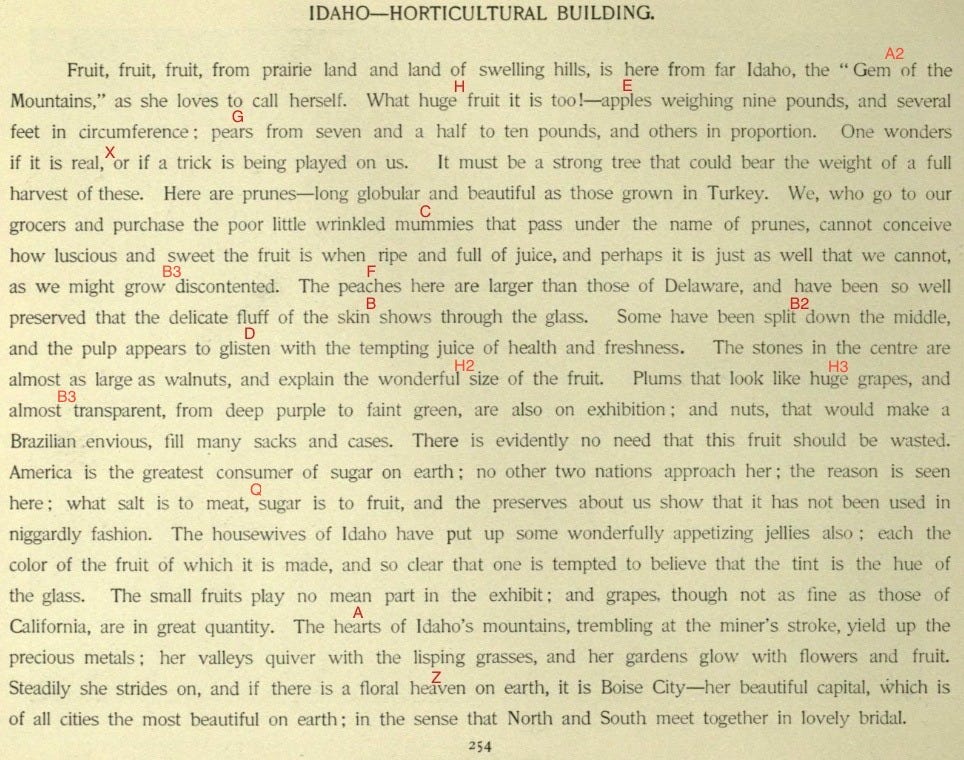
NOTE (A): The hearts of Idaho’s mountains, trembling at miner’s stroke, yield up the precious metals; her valley’s quiver with lisping grasses, and her gardens glow with flowers and fruit.
Special emphasis on the “trembling” and the “quivering” and the “glowing”... This is a transitional period for the “Gem of the Mountains”, from Idaho the Territory into Idaho the State — from panned-out Gold in the Mountain into ungrown Fruit in the Valley — this via the “transfiguration of the desert”, via Irrigation…
See Like: Since 15,000 years ago when it was cut so deep by the Bonneville Flood, the Snake River has tended to not share its water with its Plain. And still non-hydrated through its new “Iron Veins of Civilization”, the on-coming cultivation of the Snake River Plain requires lots of Irrigation… First waves of grand-scale Irrigation (1883 to about WW1) follow the arrival of the RR, but precede the Potato... The pre-Potato idea for the Snake River Plain is Fruit — is an irrigated garden productive of very big Fruit.
See the September Issue of The Irrigation Age, 1904:
The State of Idaho has long been known as “the gem of the mountains,” this title having been given it, no doubt, from the fact that large quantities of minerals were found in this State at an early date. That title holds good now that large areas of the State have been watered from the mountain streams and have been turned from sage brush plains and trackless areas into lovely farms and gardens.
(...)
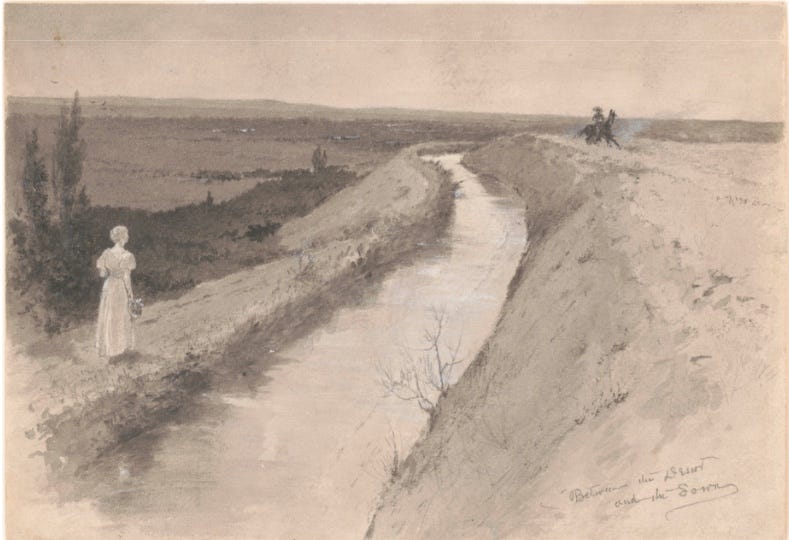
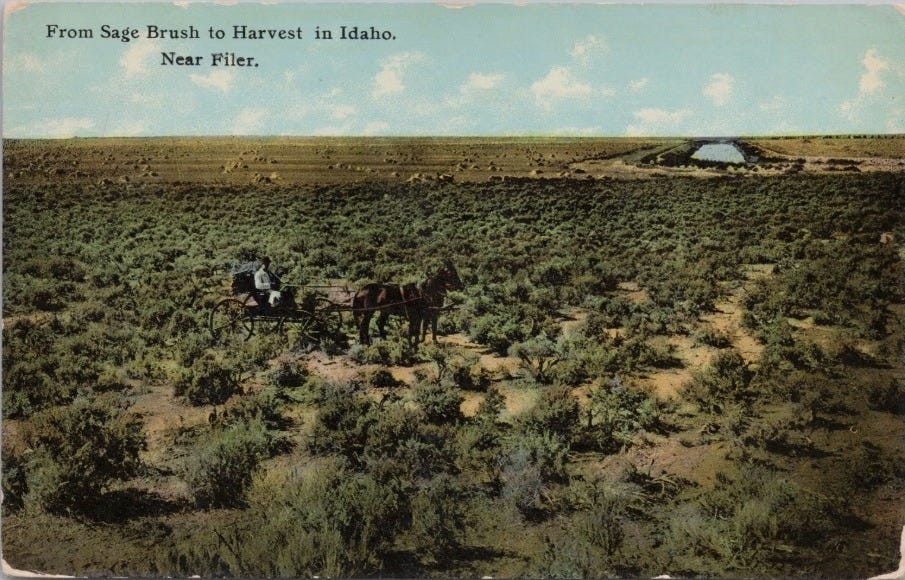
NOTE (B): …the skin shows through the glass… It is hard to see anymore the beauty we once saw in irrigation. Mark Fiege, in his Irrigated Eden (1999), points this out: Where we nowadays tend to look to the beauty of the untaintedness of the wilderness beyond our irrigated landscape, the old settlers and boosters were more-fascinated by the line that separates the two — luscious farm-moistness to the left / desert waste-grey and sagebrush to the right.
(…)
NOTE: (B2): …split down the middle…. See this drawing from Mary Hallock Foote, published in “Conquest of Arid America”, Century Magazine, 05/1895, where the line is literally the irrigation ditch, “Between the Desert and the Sown”:
Or see this postcard produced by Wesley Andrews in Baker City, OR, 1910, where the line is rotated 90 degrees — stratigraphized (?) — a good example of the visual spumoni that will become common across the Irrigated SRP:
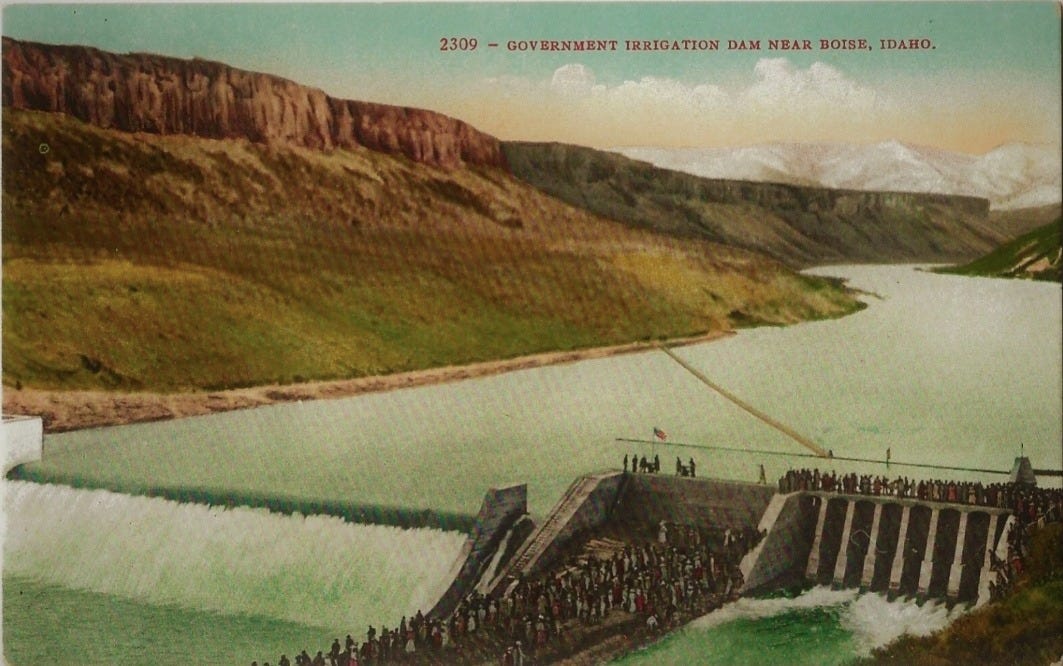
Or see this postcard, produced by Edward Mitchell in San Francisco, 1909, depicting opening day festivities for the long-coming Boise River Diversion Dam, as the line re-originates in this split between “Boise River” and “New York Canal”:
(…)
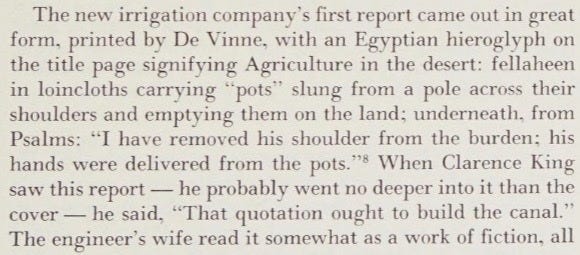
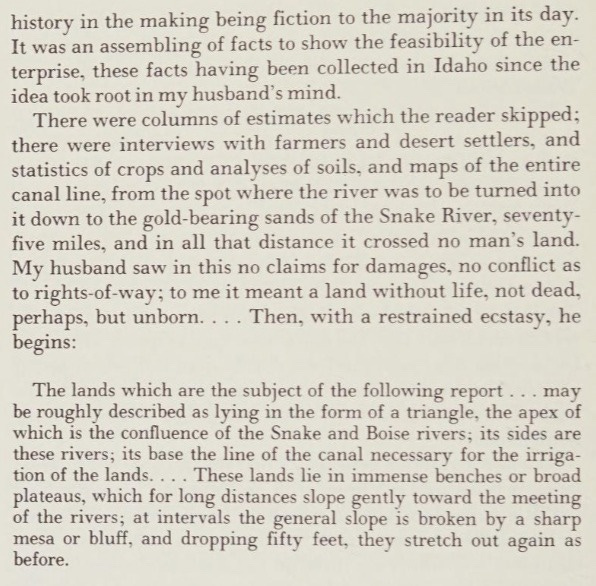
NOTE (B3): ….we might grow discontented…. It had taken 25 years... The New York Canal Idea went back to 1884, to The Idaho Mining and Irrigation Company Report, published in New York City, conceived and written by Arthur Foote, husband of Mary Hallock Foote.
In her “Reminiscences” (posthumously published as A Victorian Gentlewoman in the Far West, 1972), Foote reminisces about the new irrigation company’s first report:
(...)
NOTE (C): …mummies… See Idaho, Gem of the Mountains, published for the Chicago World’s Fair, 1893:
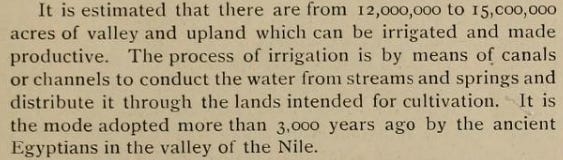
Then find (probably on the internet somewhere?) a picture of that cover of The Idaho Mining and Irrigation Company Report, 1884:
...an Egyptian hieroglyph signifying Agriculture in the desert…
Then reconsider my old notes for my old book on tape, Irrigation and Theologization (1993):
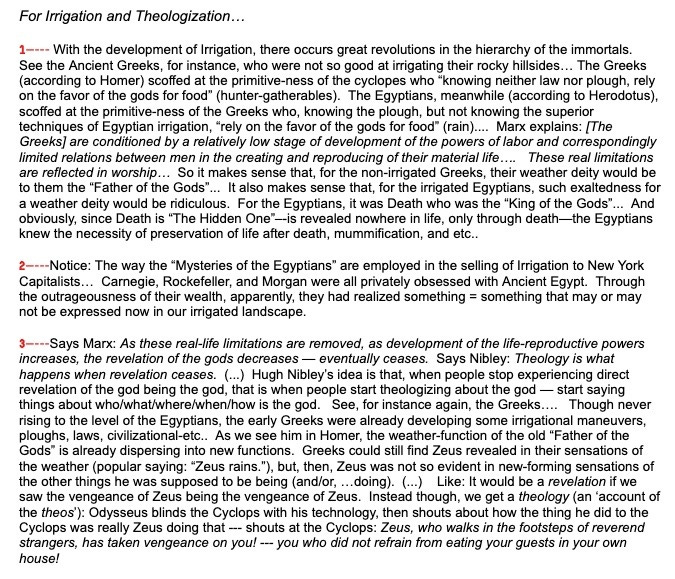
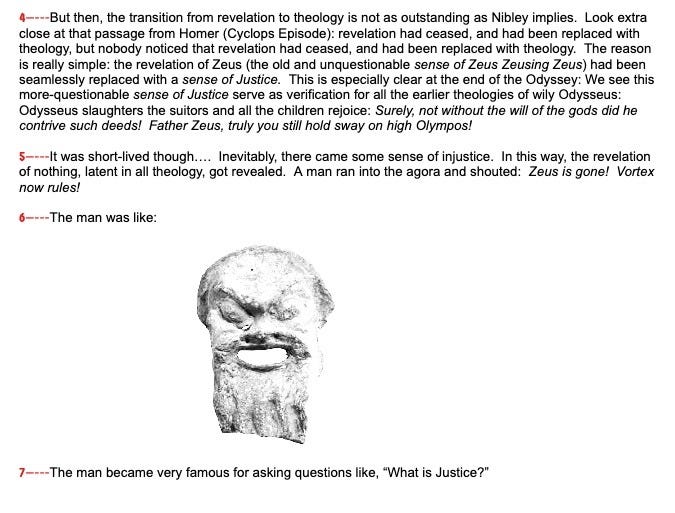
(...)
NOTE (D): …to glisten with the tempting juice of health and freshness… It makes sense that, for contrast, Boosters would want to emphasize the fruitiness of the “New West”. Basic color-theory tells us that, against a sagebrush backdrop, a red apple pops much better than a potato.
See Foote’s first view of the Snake River Plain, stepping off the train in 1884, onto a wooden platform called “Kuna”:

(...)
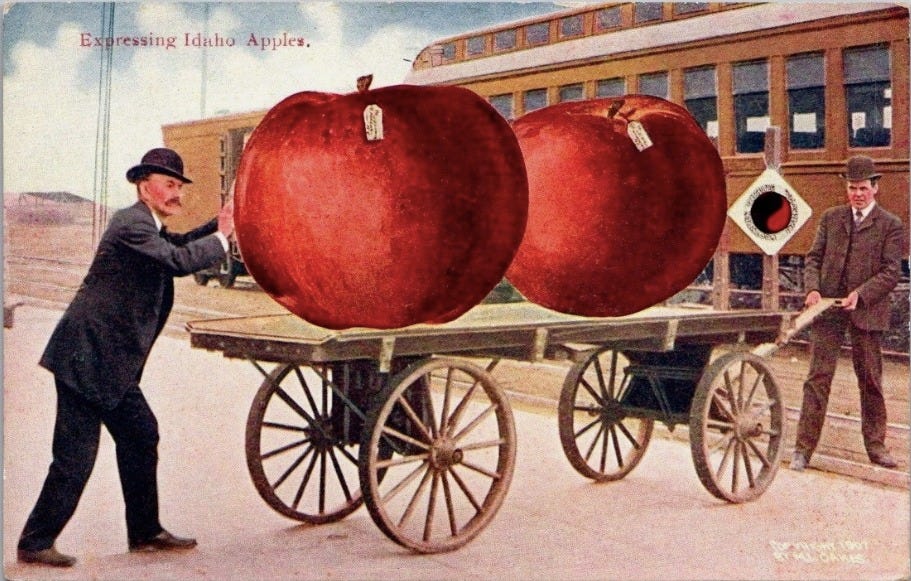
NOTE (E): …apples weighing nine pounds, and several feet in circumference…
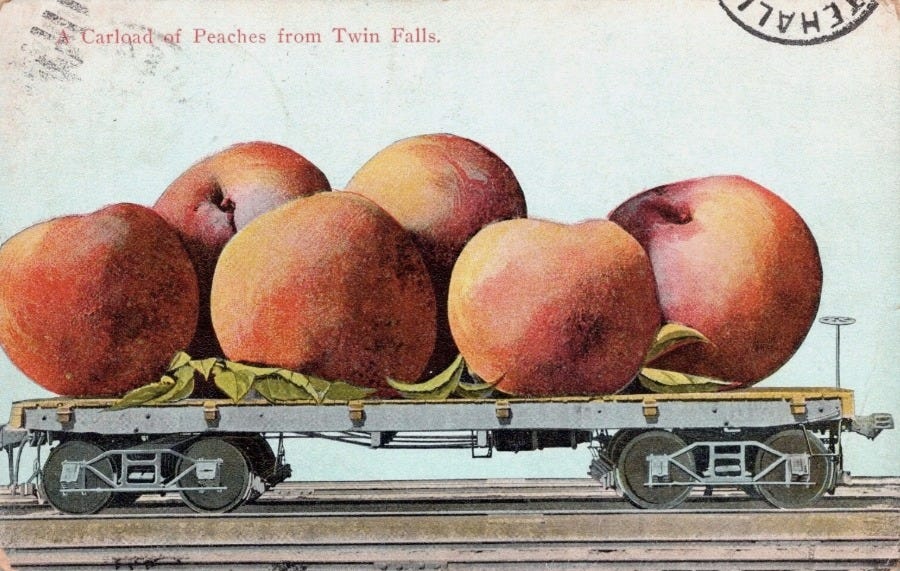
NOTE (F): …peaches…
NOTE (G): ... pears…
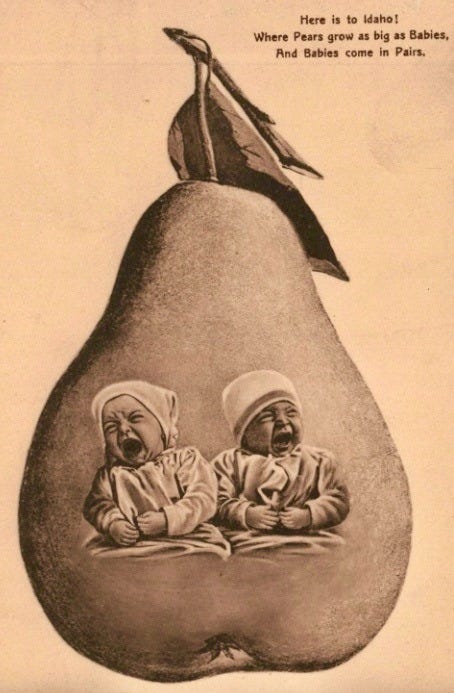
((( —1 — )))
(….)
NOTE (H – H2): …huge fruit…the wonderful size of the fruit… Generally speaking, across the Irrigating Era of the American West, this is a standard boosterism. It is a lie, obviously… Or at least, insofar as History is still being made, it is a lie, initially… Via the advent of new 20th-Century trix, what were recently ‘just words’ are transformed into realistic-looking pictures.
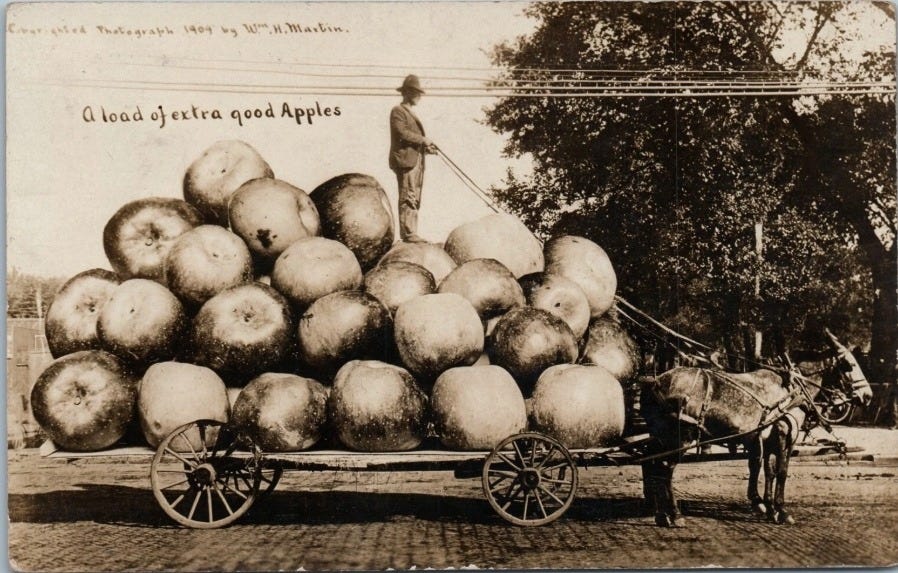
Still unbelievable of course… But then, this is what County Fairs will be for: to mine local Reality for its best approximation of the Unbelievable. Blue Ribbon Fruit will be unbelievably big fruit. It will be Real and Unbelievable and, not surprisingly, tasting like dogshit. History will have been made, but it will have been made with idiotic priorities: to make true the lies of the Boosters... Judgement Itself will be compromised.
See page 231 of Annie Pike Greenwood’s We Sagebrush Folk (1934):
After my experience in failing to take the prize for my Golden Bantam corn, I have never entered anything again. I should not have minded if I’d been beaten. I had raised perfect corn, and I looked the patch over for two ears, the entry required, that would be the exact counterpart of the illustration on the front cover of Burpee’s catalogue. I found them, just a few inches long, every kernel as it should be, even to the end—plump, perfect ears. I should have adopted the stratagem of fastening them to the catalogue cover, right over the illustration, but the judges would not have believed their eyes. They were the kind of judges whose only criterion of excellence is giantism. They had not learned that vegetables have the equivalent of hyperactivity of the thyroid gland and that oversize is always at the expense of some other important attribute. The Golden Bantham corn that took the prize was at least a foot long, almost snow white, a thin cob, kernels diminishing and disappearing at the end.
(...)
(…)
[see BIG POTATO]
(...)
NOTE (X): One wonders if it is real, or if a trick is being played on us… Say Like: “Are these the machinations of one who loves us, or of one who is just using us?” No definitive answer yet. But in time… Irrigation must eventually clarify its allegiance here — the true heart of its provisionally dubious creator. The day of this clarification will be Judgement Day in the Snake River Plain. 2
See the prophecy of Isaiah, Chapter 35, Verse 1: The wilderness and dry land shall be glad, the desert shall rejoice and blossom like the Crocus.
See Verse 6: Streams shall burst forth into the desert…
See Verse 6: The lame shall leap like the deer…
See Verse 8: A highway shall be there…
See the more-recent prophecy of Micron CEO Sanjay Mehrotra, standing not far from the Old Oregon Trail with a mayor, a senator, a governor, and shovel: Over the coming years, the desert around us will be completely transformed….
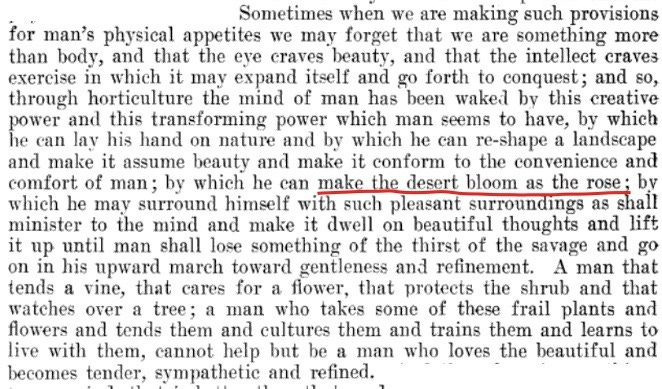
See the Transactions of the Illinois State Horticultural Society, 1911:
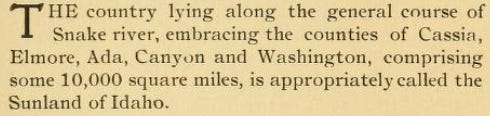
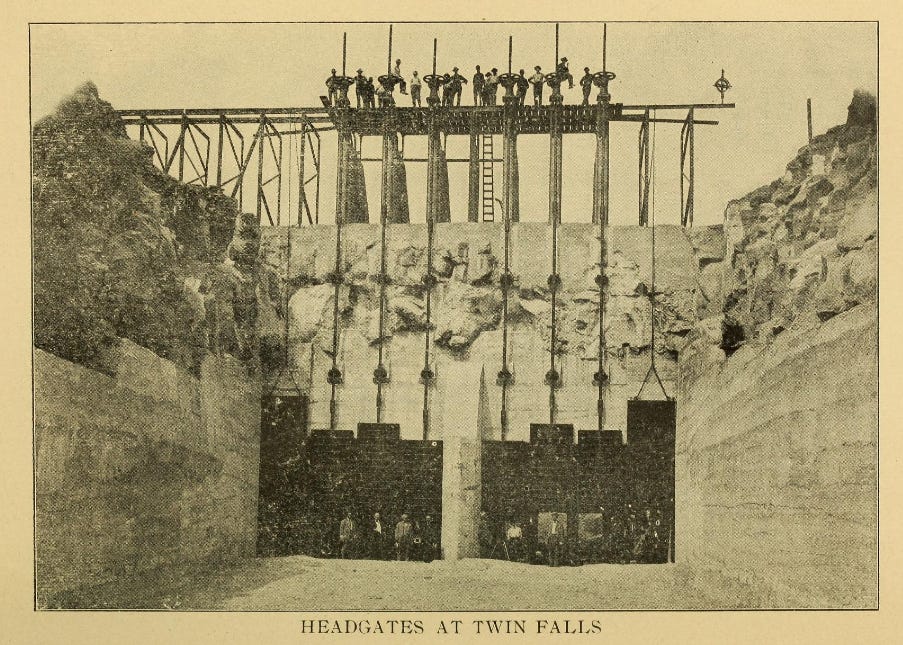
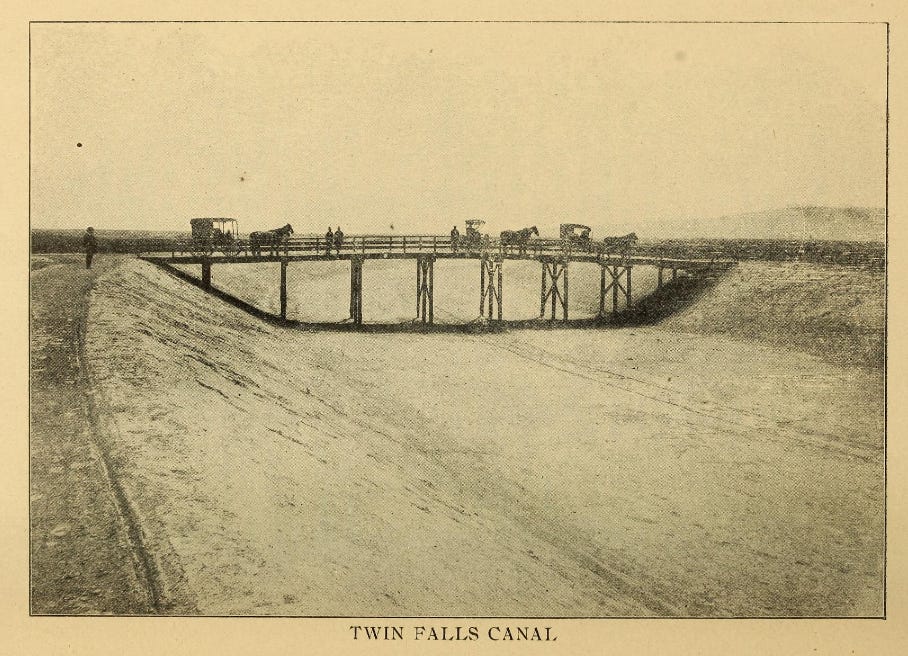
See The Sunland of Idaho, published by the Bureau of Immigration, Labor and Statistics, 1905:

(...)
NOTE (Z): …a floral heaven on earth… Fruit requires Orchard. Orchard, to me at least, implies some sorta Paradise... A sorta childhood frolicking through some sorta orchard…. The Bible tells us that this is what our loving Creator created for us, in the beginning, with the Gardens of Paradise...
Orchards are laid out “quincunxially” — in “quincunxes” — which is the plural form of “quincunx” — which is the Ancient Roman word for

It is the most beautiful of the basic configurations. So says Quintillion in his Institutes of Oratory, c. 35 aZ:
What can be more attractive than the well known quincunx which, in whatever direction you regard it, presents straight lines?
The Boise Evening Capital News, 1/1/1913, agrees:
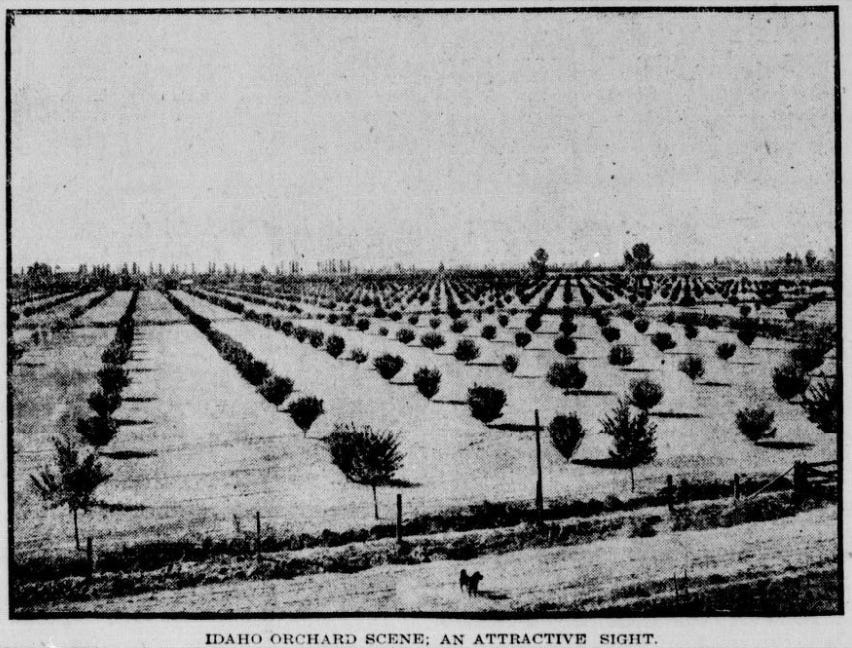
It is is the most space-efficient way to plant trees — maximum root-room, etc. — and also the basic element in the thing Sir Thomas Browne named a “network”. 3
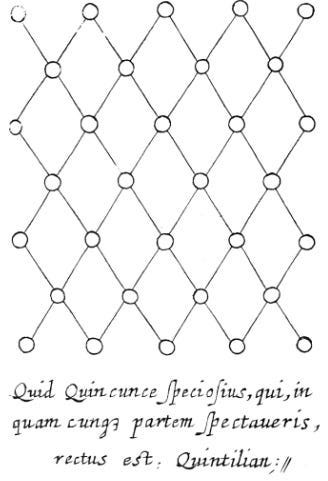
For the best book about quincunxes, see Sir Thomas Browne’s The Garden of Cyrus, or, The Quincuncial Lozenge, or, Network Plantations of the Ancients Artifically, Naturally, and Mystically Consider’d (1658).... Here, Brown considers the quincunx, “artificially, naturally, and mystically”, as he traces the configuration’s diffusion from the quincunxial Gardens of Paradise, into the networked orchards of the ancients, into various patterns in Nature, into the animals, into the most-basic infrastructure of animal vision…
For all things are seen quincuncially; for at the eye the Pyramidal rayes from the object, receives a decussation, and so strike a second base upon the Retina
…then into the soul, where this “quiet vision” is further refracted—where its “light is but the shadow of God”---and then, finally, into the basic formula of the Apocalypse.
The book concludes with this sentence:
All things began in order, so shall they end, and so shall they begin again; according to the ordainer of order and mystical Mathematicks of the City of Heaven.
(.…)
NOTE (Q): ...what salt is to meat, sugar is to fruit… Compare and Contrast: The way forests are — the way trees order themselves when they plant themselves… Say: In the “Order of the Forest”, the spatial concerns that dictate the quincunxial “Order of the Orchard” are mixed with, and often subordinated to, temporal concerns. Seniority, for instance…. In the Orchard, there is a simple equation that determines ground-space per tree: ground-space / number of trees = ground-space per tree. In the Forest, meanwhile, this equation is still active, but seems generally subordinated to matters of seniority.
Also relevant are questions of personality... The way a specific tree shares its space with its fellow trees and treelings is expressive of what we might call its “personality”. Probably more than any other variable, it is this personality of trees that makes it so difficult for human mathematicians to describe the Order of the Forest.
Like: There are lots of different Orders of the Forest. Different Trees work together in different ways. Others work all alone. See the order of the Lone Juniper on the hillside…. See the Order of the Sagebrush Sea…
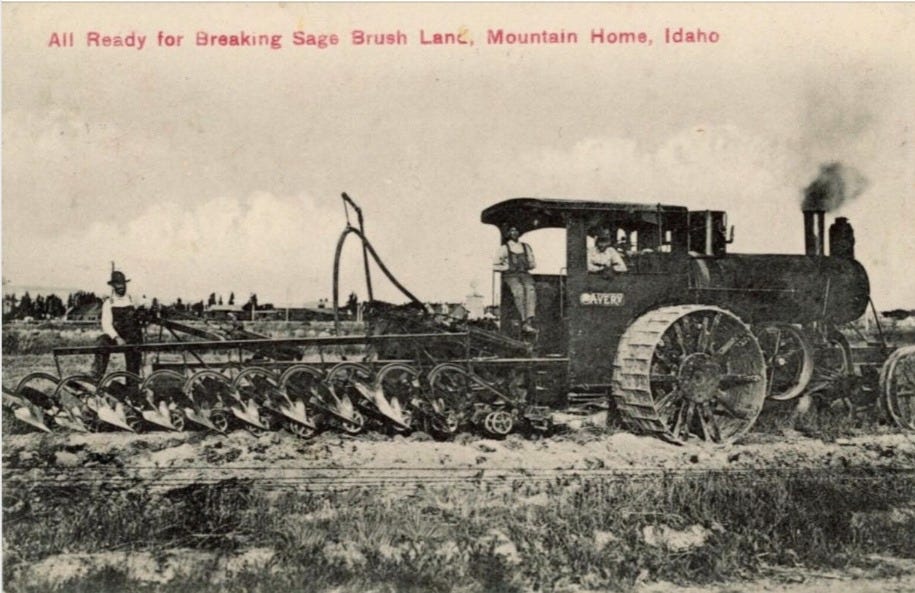
Like: Though certainly still present in the Order of the Orchard, personality is suppressed. And there is only one Order of the Orchard. A good analogy is a school for British Boys: Everybody must be the same age, must be looking the same, and must be behaving in the same way.
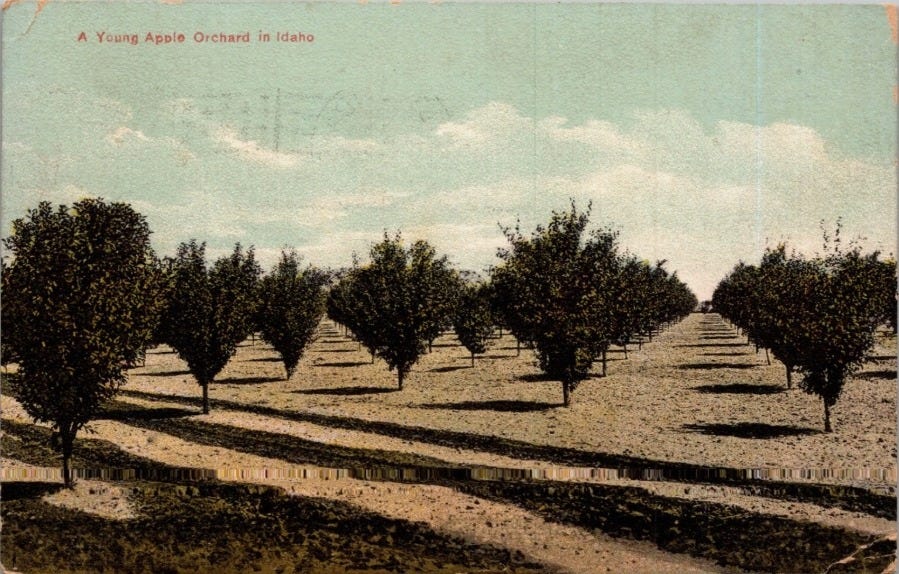
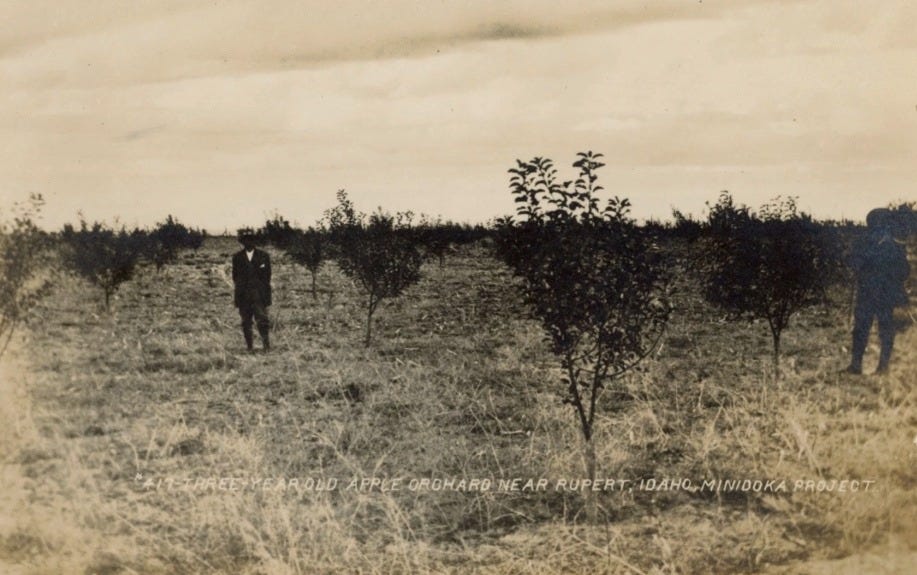
Like: The Order of the Orchard is also the Order of the Tree Farm. And with increased human intervention (bulldozing, logging, replanting, etc.), the Order of the Forest is increasingly mixed with the Order of the Tree Farm. Whether this is making the mathematicks simpler or more complicated is not yet determined.
(.…)
Some question whether this is the original…. Image and text are reproduced and colorized in postcards for both Washington and Oregon.
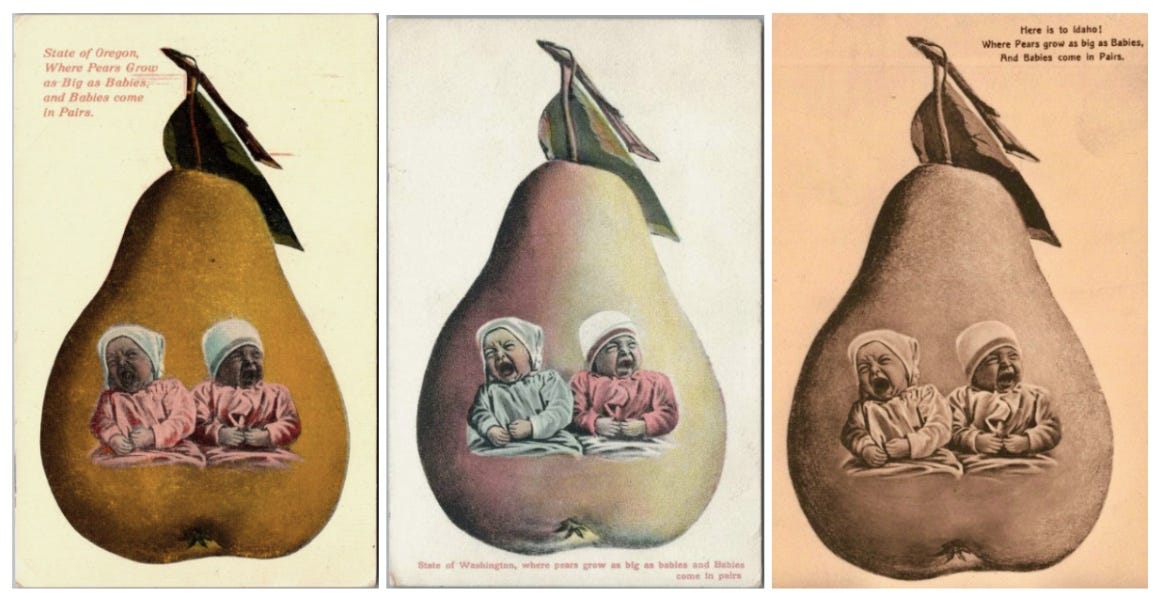
Not uncommon either way. Locations are usually interchangeable in these Irrigation Postcards — often just a space left blank by the publisher.
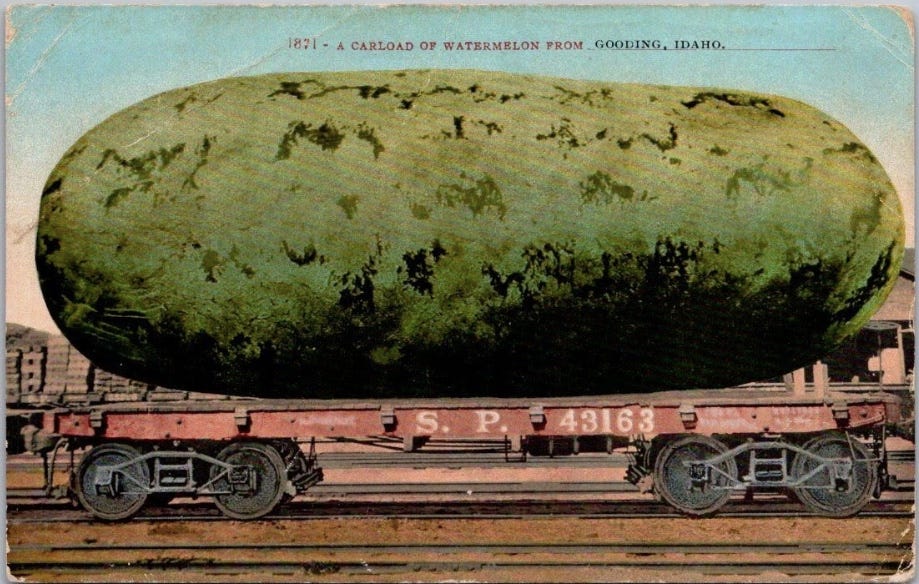
For more on this see BIG POTATO…
Just walked to the Stinker and the Attendant put this perfectly: He was double busy. He told me his co-worker had run off saying it was urgent and he would be back in a minute, but that that was two hours ago. Attendant said, “I don’t know if I should be worried, or pissed, or excited….”. Playing on the radio was the Tom Petty song about how the hardest part is “The Waiting”. We hi-fived and I said, “You The Boss Now”. I couldn’t think of anything else to say. He didn’t offer me a bag but I was OK with that. Plastics, I am confident, are bad.
Three more words invented by Thomas Browne.: electricity, computer, suicide. Three more: hallucination, follicle, medical. Three more: approximate, coexistence, ambidextrous.
… the Idaho potato may be the only produce that tastes ok at truly giant sizes.
Good to see the pre cursor of Ai/photoshop constructed images goes back a long ways. People have always loved “larger than life” possibilities. Fruit seems to be a big target for this enhancement. We did a lot of design work for growers in California like SunMaid raisins and Diamond Walnuts throughout the 90s. There was one particular report in which we replicated old fruit crate labels with GIANT produce.